
After hacking my way through After Effects (AE) for multiple projects for my masters program, I began looking for options on how to quickly get a better grasp of AE.
Enter School of Motion fall 2022, when I was finally able to take an After Effects Kickstart class one of their many design & animation related classes.
Not only was I interested in becoming more proficient in AE, but also as an ID student was equally intrigued with the structure and experience of their online class. While enrolled, I worked to identify how they approached common ID issues, like Content? Pacing? Organization? UX design? Student engagement? Motivation? Accessibility? Community? Feedback? Learning goals? Analysis? and more.
This post is not meant to be a complete overview of AE Kickstart, and is certainly not a 15-page ID evaluation, rather it is a simple snapshot of what perhaps may be the two biggest design challenges facing this type of online class, and identifying School of Motion’s learning goals and how they may be tracked.
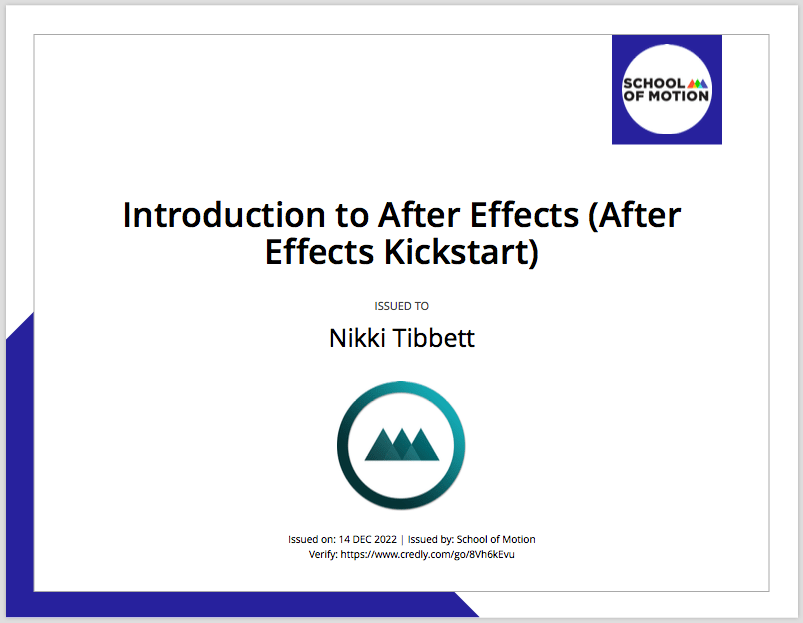
- 8 Week Course
- $795
- Fast-paced, Project Based Learning experience
- Designed for adult learners
- Easy navigation
- 8 learning modules
- Modules include:
-lesson videos with SME
-bonus content
-instructional pdf’s
-real world problems
-podcast
-guided projects - Prerecorded lessons by Nol Honig, subject matter expert in AE
- Provided with a teaching assistant, during the 8 weeks
INTRODUCTION: School of Motion has a wide offering of online classes focused on design, animation, and 3D courses. The courses are designed to create as close to a real-world experience as possible, which means students are introduced to a realistic problem, and face challenges as they actively work to solve that problem, and in the case of AE produce a public product.
INSTRUCTIONAL DESIGN: I am certain that School of Motion faced several instructional design challenges when creating their online distance learning curriculum. Perhaps the most pressing, would be the tremendous diversity of their students, not only do their (mostly) adult learners come in with a wide variety of previous learning experiences, they also vary in culture, ethnicity, language, sex, and race.
For example, I am an English speaking student, who had previously been hacking my way around AE and so had a basic understanding of the programs layout, key frames, and properties (although I didn’t know to call them “properties” at the time). And yet, even with the my prior knowledge, I found the pace of the course challenging. I would assume the pace may be even more difficult for second-language learners or those with learning challenges. As well as, those who do not have the prior knowledge of properties, keyframes, or the way AE is structured. Scaffolding, particularly online, for this type of learning experience would be extremely difficult.
In addition, School of Motion would be faced with simple online classroom structural issues. How does an online course go about organizing the massive amount of information students will receive? In this case, School of Motion delivers an easily consumable product by designing their course in modules, each module holding 1-2 lessons, bonus materials, podcast, examples, and corresponding project.
LEARNING GOALS: It seems obvious that School of Motion would like AE Kickstart students to walk away from the course with a working knowledge of AE and be able to apply that knowledge in a real world setting. However, as I progressed in the course it seemed that another of their primary goals is for learners to understand what it is like to be a motion graphics animator, or better put, the work-life of a Mograph artist. In fact, based on the structure of the course and focus of the content, it seems this may be their primary goal, but perhaps this is just my perspective.
As a way to meet the first goal, Kickstart provides a top quality teaching with an engaging expert in his field, Nol Honig. Although prerecorded…Nol manages to make the learner feel that he is speaking directly to you, walking you through the intricacies of his process. Each module also provides students with a PDF recap for that instructional unit, as well as, additional PDF’s for bonus content. In some ways, the PDF recaps serve as a summary of the learning targets students should meet in each section.
As an example, the above video that was made after taking Lesson 2, where students were introduced to and asked to perform, audio scrubbing, using layer markers to indicate important transitions in audio, and understand an audiowave form. As well as, an introduction to and basic understanding of design concepts like color and font. In this video, my TA offered constructive feedback on areas where my “value structure,” could improve. I found his input to be very helpful, even though I had to ask for clarification on what various terms meant, as I do not have any design background (a great example of the diversity of student experiences).
However, where Kickstart really shines is for those interested in pursing a career in Mograph. The entire learning experience is geared to create a mograph life, e.g., the process of creating a video, connections to Kickstart school community, connections to the broader mograph community, podcast, inspiration, and insider tips and tricks, etc.
SUMMARY: School of Motion is a business of excellence. They strive to provide the best information, teaching, materials, support, communication, feedback, motivation, community, and more. Although they faced many instructional design challenges, they seem to have met most learner needs, and if not, be consistently working to modify and improve the learner experience. One example of their dedication to their students, among many, is that they have an entire page dedicated to constructive and critical feedback. They thrive on critique, and this mindset is absolutely inspiring ! If I were to offer one piece of ID advice to SOM it would be to offer a feedback survey after each module. This would help them to track, how long it took the student to finish the material, how engaging the module was, how the module could be improved, etc. They may find the information insightful and could inform their future tweaks in the class.
After taking After Effects Kickstart, I am more confident in my ability to use After Effects, as well as, have several new tools that I was immediately able to implement while using the program. However, I also have several areas of learning that were covered in AE Kickstart, but that I did not learn well enough in the timeframe offered to confidently execute later on my own. Thankfully I have lifetime access to the course and can go back and rewatch the teaching videos to actually grasp some of the more difficult lesson. Although going back is a bit clunky, this option is still invaluable for a busy adult learners who want to realize the full value of the course.
Even though I did not, and still do not, have the goal to become a Mograph artist, I am pleased that I took the class to build my skills in AE. I would happily recommend After Effects Kickstart to those like me, who are most interested in gaining a better understanding of the program. However, for those who want to make motion graphics their field, I would say this course is a MUST-take, not only is it a great way to learn, but also connect to a vibrant creative community.


 nikolaidesigns.com
Leave a Reply